23rd March 2026
Keep Your People at the Centre: 6 Strategies for Success

Organisations improve performance by shifting from process-led HR to experience-led design. Sonia Mooney explains that co-creating with employees reduces friction, increases engagement, and boosts productivity. By focusing on how work feels, not just what gets done, organisations unlock capacity, build trust, and create more effective, human-centred workplaces.
This article was written by Sonia Mooney and published here.
The Employee Experience Perspective
For every organisation, our people are our business. And they’re the most valuable asset that we have. It’s our people who create, deliver, build, solve, support and serve. They’re the enablers of the business strategy.
Our people’s experiences are key. If we want our HR function, and our organisations to succeed, we need our people to succeed. When the employee experience is positive, people feel supported, engaged and able to deliver. When it’s not, performance is affected. Friction builds, energy drops, productivity declines. The ripple effects can be huge – affecting engagement, discretionary effort and ultimately business outcomes.
We all want our people to have the best experiences. So, what’s stopping us?
In my book, High-Impact HR, I share the full approach and tools behind these principles. It’s available here.
The Problem with HR Processes
Our HR processes make up a huge part of our landscape, our HR operations – and the end-to-end employee experience. They’re the invisible threads that hold everything together. They’re also one of the most overlooked areas in HR transformation. Because your HR processes are either moving you towards your business goals – or away from them.
We have so many products and services within our HR function – and every one of them has a process behind it. Do you know how your HR processes feel for your people?
Transforming your HR processes isn’t just about making things faster. It’s about unlocking capacity, reducing frustration, enabling people to do their best work and creating a more productive organisation.
From HR Process to Employee Experience
It’s easy to believe that designing around process, or our HR policies is the only way. After all, there are things that we need to get done. But when we design solely based on our needs, or through the lens of an HR specialist or HR professional, we often end up with processes that are simply not intuitive. They’re not easy for people to find their way through – and the business impact is often far greater than we realise. Shifting to an experience lens changes everything.
Transforming your processes isn’t just about making things faster. It’s about creating a better organisation. To unlock the true value of our people we need to make the shift from HR process – what we need to get done, to employee experience – how it feels for an employee when they’re trying to get things done.
Focusing on HR process alone – without considering the experience – is counterproductive. And ineffective processes are one of the biggest barriers to organisational performance. They create friction and drive waste – both for employees navigating these processes, and for the teams managing the fallout.
Shifting to an experience lens is a very different way of thinking about our HR activities – and delivers much better results. The best processes are often invisible, they feel seamless. People don’t get stuck, they don’t need help, and they don’t even stop to think about the process – because it works.
Design With Your People
Designing your products and services without including the people who are going to use them is a mistake. Because what often happens in reality is that we unconsciously line up problems for the future. But unless you have a holistic view of your HR landscape you might not even realise – you’ll just be dealing with the fallout. You’ll be fixing the symptoms of the problem – not the root cause.
Effective HR processes don’t just come from expert design. They come from shared design. When we bring our people into our world – to be part of the creation process, together we can shape solutions that are not only streamlined, they’re effective and compliant, and easy to use which results in strong adoption.
This approach stops waste before it starts and delivers efficiencies, as well as providing a much better employee experience. This positively impacts engagement levels, productivity and business outcomes. Co-creation isn’t a nice-to-have – it’s an essential business strategy. When we design with our people, not for them, this helps to identify blind spots, remove friction and design effective processes that are not only effective and compliant – but intuitive and human – processes that your people will actually use.
When we’re looking across our functions, our HR tech landscape is a key area to focus on. Get your HR data, your HR technology and automation functionality working hard for you. Use your data and insights to help you identify pain points and waste, then automate where you can. Shape an HR systems and workflow architecture that supports your HR department, operational teams, and your employees – every day.
This approach works whether you need to redesign an entire product or service end-to-end, refine the employee experience in relation to your HR system, or simply address a particular pain point that’s arisen.
If you’re ready to focus on HR process improvement, and start shaping processes and employee experiences that drive better business outcomes, as well as building credibility and trust with your people and organisation, here’s how to get started:
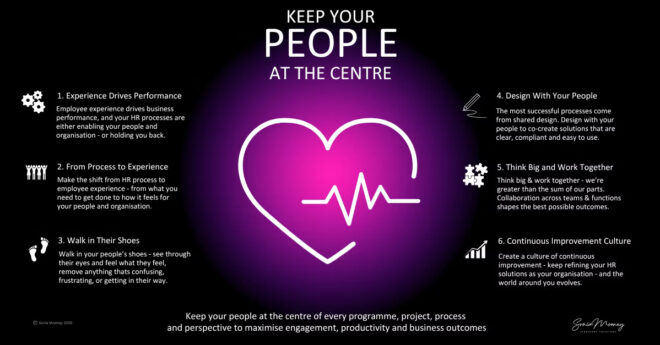
1. Experience Drives Performance
Keep in mind that your employee experience drives business performance, and your HR systems and processes are either enabling your people and organisation – or holding you back. Which category do the processes in your HR department fall into?
2. From Process To Experience
Make the shift from HR process management to designing around the employee experience. This means a mindset shift from focusing onHR process alone – and what you need to get done as a team or function, to how it feels for your people and organisation.
3. Walk In Their Shoes
Walk in your people’s shoes – see through their eyes and feel what they feel. Shape streamlined processes – remove anything that’s confusing, frustrating, or getting in their way.
4. Design With Your People
The most successful processes, and best practices come from shared design. Design with your people to co-create processes and experiences that are clear, compliant and easy to use with strong adoption.
5. Think Big and Work Together
Think big and work together as an organisation – we’re greater than the sum of our parts. Collaboration across teams and functions shapes the best possible business outcomes.
6. Continuous Improvement Culture
Create a culture of continuous improvement – keep refining your HR solutions as your organisation – and the world around you evolves.