02nd December 2025
AI Is Changing How Work Gets Done: How to Prepare Your Workforce for the Future

In 2017, when AI pioneer Andrew Ng described artificial intelligence as “the new electricity” and argued it would transform every major industry, many outside the tech world treated it as a bold, though somewhat exaggerated prediction rather than an immediate reality.
Fast forward to today, where research from Microsoft shows around 75 percent of global knowledge workers have already used generative AI tools in their jobs, often introducing them into corporate environments long before formal policies or structured training exist.
However, widespread experimentation doesn’t equate to mature adoption; a global workforce study by PwC found only 14 percent of workers use generative AI every day, even though more than half have tried it at least once in the past year, while other surveys indicate only about one third of employees have received any formal training. This leaves a large share of the workforce essentially self-taught and forced to improvise with powerful tools in high-stakes contexts.
This gap between AI presence and AI proficiency creates a growing structural problem at the organizational level, rather than a minor growing pain in technological adoption. An analysis from Boston Consulting Group across more than 1,200 companies suggests that, although most organizations are investing in AI in some form, only about 5 percent consistently achieve measurable business value in the form of revenue gains, cost reductions, or redesigned workflows. That means AI often remains trapped in pilot programs, side projects, and individual productivity shortcuts while the core operating model and talent strategy still reflect a pre-AI world.
In this article, we’ll examine whether AI is truly changing how people work or whether parts of the narrative remain overhyped, then explore practical ways to identify the AI-driven skills gaps forming inside your workforce. Lastly, we’ll lay out a five-step approach to prepare people for an AI-driven future through targeted upskilling and reskilling.
Is AI really changing how people work?
Although AI feels overhyped, the workplace has changed substantially since the launch of GPT-3, both in how people talk about their work and how they get it done.
Professionals now routinely turn to tools like ChatGPT or Copilot to brainstorm ideas, structure documents, or draft first passes of emails and presentations—often before their employers have decided how to govern these tools.
This behavioral shift shows up clearly in data: The Microsoft Work Trend Index reports that a large majority of knowledge workers have already used generative AI at work, while the Salesforce Generative AI Snapshot finds roughly three in five desk workers now employ AI tools daily and credit them with higher productivity, sharper focus, and better momentum on complex tasks.
In practical terms, this means that for many knowledge workers, the “first draft” of a document, the outline of an analysis, or the structure of a presentation is shaped by AI, even though final judgment, strategic framing, and accountability still sit firmly with humans.
The most meaningful shift, however, sits at the level of tasks rather than entire jobs, which is where some of the “AI will replace everyone” narrative loses credibility. The describes generative AI as a technology that primarily reshapes the mix of activities within existing roles, by automating routine or repetitive components while amplifying human strengths in synthesis, reasoning, and problem solving. Meanwhile, the shows that, in some occupations, a very high share of activities can be automated with current or near-term AI, whereas in many other roles, the dominant effect lies in support and augmentation rather than direct substitution.
Analyses from institutions such as the suggest that, in advanced economies, a significant portion of jobs are exposed to AI in some capacity, with roughly half of those likely to benefit through higher productivity, and the other half facing more serious automation pressure, which paints a picture of reconfigured work rather than a single, uniform wave of displacement.
At the same time, the feared tidal wave of immediate job losses has not arrived in most sectors, especially among smaller organizations, which is why the most extreme short-term claims remain unhelpful for serious workforce planning. Recent work by the reveals more than four out of five of these firms report no change in overall staffing needs from generative AI so far, with only small minorities stating either higher or lower head counts as a direct consequence of adoption. Broader reviews from the OECD and similar bodies frame AI as a general-purpose technology with substantial potential for productivity and innovation, while emphasizing that long-term labor-market outcomes will heavily depend on how organizations redesign jobs, invest in skills, and support transitions.
Taken together, the evidence indicates AI is changing how people work in concrete, task-level ways, even though the headline narrative often exaggerates the pace and scale of disruption and underscores how leaders who treat upskilling and reskilling as strategic levers will shape those outcomes far more than the technology will on its own.
How to identify the skills gaps AI creates in your workforce
AI capabilities are moving faster than most learning cycles. New tools reach employees before role definitions, training programs, or career paths can adapt. Research shows many technical and digital skills lose significant relevance within just a few years, which means gaps open the moment work changes, and the workforce doesn’t reskill fast enough. The question isn’t whether skills gaps exist—it’s how quickly you can identify them, how precisely you can locate them, and how systematically you can close them.
Step 1: Map where AI reaches work today
The first step involves identifying where AI already appears in day-to-day work, including informal and experimental usage that doesn’t show up in official project plans. Leaders can ask teams which tools they use to draft content, analyze information, support customers, or design solutions, then connect each tool to the specific tasks it speeds up or automates. This exercise should produce a focused view of AI-exposed activities across roles, showing where manual work has shifted, where new tasks have emerged, and where people feel either empowered or stretched. Without this map, any conversation about skills will remain abstract, because there is no clear line of sight between AI capabilities and the tangible results people are expected to deliver.
Step 2: Translate AI-influenced tasks into a clear skills blueprint
Once AI-influenced tasks are visible, organizations need to describe them in the language of skills rather than that of tools. Instead of saying someone “can use ChatGPT” or “feels comfortable with copilots,” the blueprint should spell out underlying capabilities such as prompt design, critical evaluation of AI outputs, data literacy, workflow design, or ethical judgment when AI informs decisions. That blueprint should also cover complementary human skills that gain importance when AI enters the workflow, including problem framing, stakeholder communication, and cross-functional collaboration around AI-enabled processes. When roles are defined as clusters of skills rather than static responsibilities, it’s much easier to see where AI has raised expectations for particular capabilities, even though the job title itself hasn’t changed.
Step 3: Build an honest, multi-source view of current skills
The next requirement is an accurate picture of the skills that exist in the workforce. This usually entails combining several sources like self-assessments, managerial perspectives, profile data, learning histories, internal mobility patterns, and sometimes inferred skills based on delivered work. Modern talent platforms and internal marketplaces help employees uncover skills, aspirations, and experiences that don’t appear in traditional systems. This also reveals pockets of AI readiness that might otherwise stay invisible. When organizations assemble this multi-source view, they replace guesswork about “who is good with AI” with a more reliable understanding of who has which capabilities today.
Step 4: Compare required skills with current abilities to pinpoint AI-driven gaps
With a clear skills blueprint on one side and a robust skills inventory on the other, organizations can start to compare role needs against what people currently possess. The most useful analysis highlights teams or segments where AI-exposed tasks are expanding quickly while proficiency in AI-related or complementary skills remains shallow, scattered, or concentrated in a few individuals. This comparison makes it possible to distinguish experimental gaps, where AI usage remains low in consequence, from critical gaps, where missing skills threaten productivity, customer experience, or strategic initiatives. When leaders can point to specific roles, tasks, and skills rather than broad concerns, the conversation about AI risk becomes sharper and far more actionable.
Step 5: Validate the data through experience on the ground
Even the best skills data needs to be tested against the day-to-day reality because dashboards can’t fully capture how work feels for employees. Managers can validate the picture by asking where work slows down, where teams lean heavily on a small group of “AI fluent” colleagues, or where quality issues emerge when AI tools join the workflow. Employees can share where they feel confident, where they feel exposed, and where they improvise without guidance, which often reveals hidden gaps in areas like critical thinking about AI outputs or integrating AI steps into existing processes. When organizations combine structured skills data with this lived experience, they move from a vague belief that “we are behind on AI” toward a specific, prioritized map of gaps that AI is creating, which sets a much stronger foundation for serious upskilling and reskilling efforts.
Five practical steps to prepare your workforce for an AI-driven future
Once you can see where AI is creating skills gaps, the real work begins. The goal is to craft a repeatable sequence that helps people understand what will change in their roles, build the right skills, and practice them through work.
The most effective organizations define the skills that matter, make AI-driven career paths visible to employees, link gaps to concrete development, create stretch opportunities, and use data to keep the whole system aligned. Fuel50 is built to support that exact progression through features that turn skills strategy into an everyday employee experience.
Step 1: Define AI-critical skills for every role with a clear blueprint
Preparation starts with clarity about which skills matter in an AI-enabled version of each role. Leaders need to translate broad AI ambitions into specific capabilities such as data literacy, prompt design, workflow design, AI governance, and complementary human skills that become more valuable when automation increases.
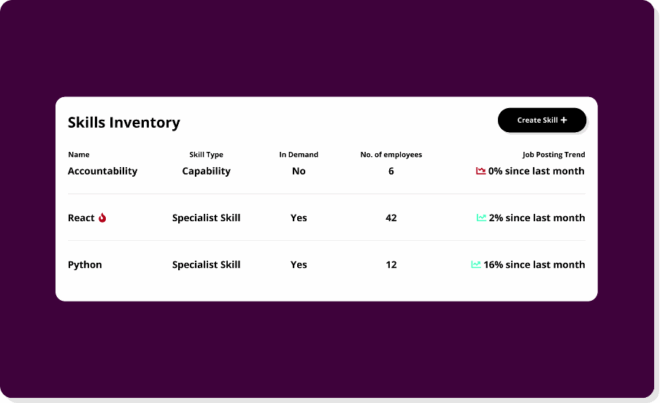
Fuel50’s Skills Inventory and give organizations a structured way to map those capabilities to roles using a curated skills ontology that reflects both internal priorities and external labor-market trends.
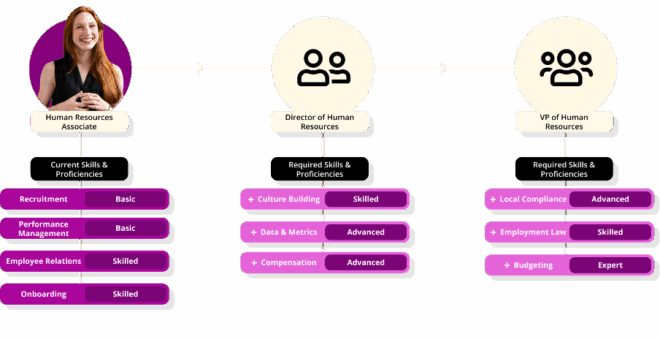
You can embed AI-related skills into the architecture so they’re “in demand,” signal where expectations are changing, and make sure every role profile reflects the future version of the work rather than a historical job description. This blueprint becomes the reference point for every reskilling and upskilling decision that follows.
Step 2: Make AI-aligned career paths visible to every employee
Once you know which skills will matter, people need to see where those skills can take them. Employees stay passive when things feel abstract; however, they become active when they can see specific roles, paths, and options that match their interests.
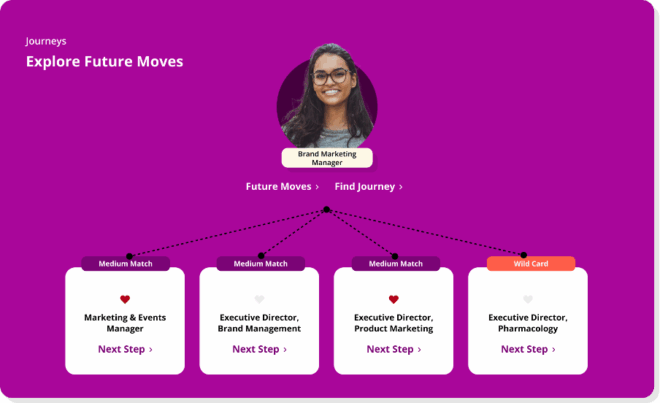
Fuel50’s Journeys transforms the skills blueprint into personalized career maps that show employees which roles fit their current profile, how AI is reshaping those roles, and which skills they would need to develop to move toward them.
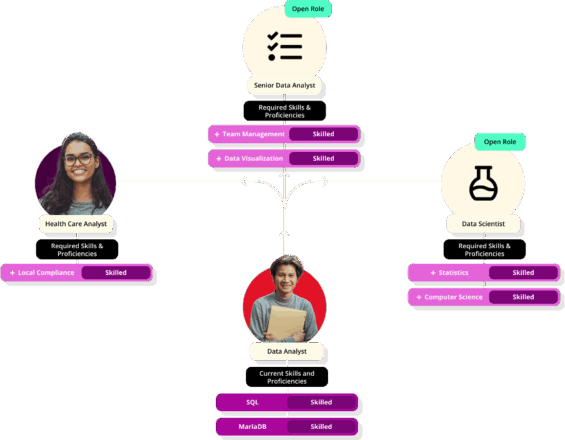
Employees can mark AI-relevant target roles, view their current match, and understand which gaps stand between their current position and an AI-augmented future role. That visibility reframes AI from a vague disruption into a set of concrete, navigable options, which is the foundation for significant upskilling and reskilling.
Step 3: Turn AI skills gaps into focused developmental plans and learning
With target roles and gaps on the table, organizations need to convert insight into action.
Generic digital training catalogs rarely change behavior because they don’t connect clearly to someone’s role, aspirations, or AI exposure.
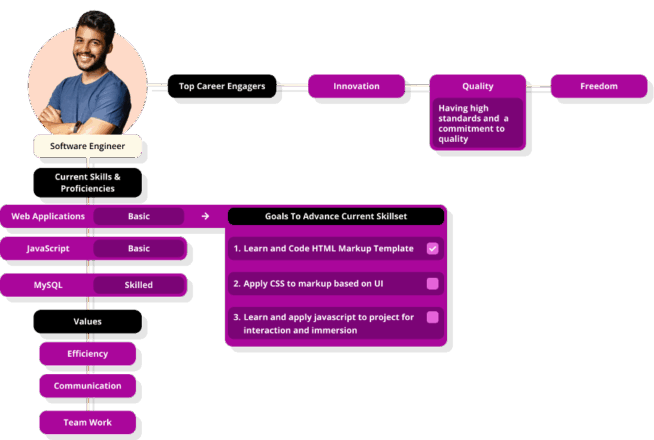
Fuel50’s Development Goals and Learn+ features close that loop by translating AI-related gaps into specific objectives, actions, and learning pathways.
Employees can set developmental goals against AI-critical skills, link them to target roles, and access recommended learning prioritized by role requirements and their current proficiency.
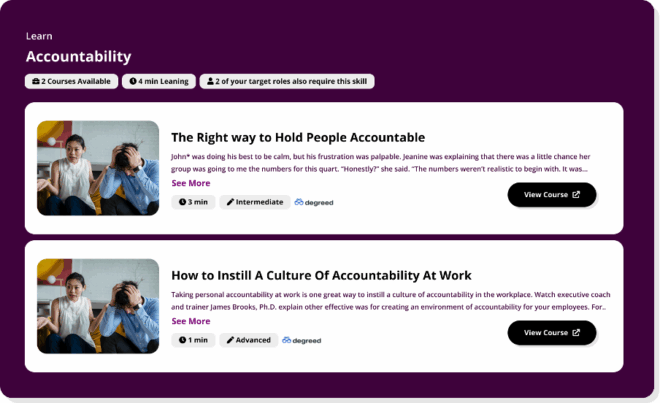
Learn+ returns courses that align with the skills required for their role or desired move, steering them toward AI-related content that matters for their future, while self-assessments and managerial feedback keep proficiency levels honest. This changes the vague “get better at AI” into a set of concrete steps that employees can track and leaders can support.
Step 4: Give people real-world AI practice through gigs, mentoring, and internal moves
No amount of formal learning will prepare a workforce for AI if people never apply new skills in their work. The next logical step is to create safe but meaningful arenas where employees can practice AI skills, experiment with new tools, and contribute to AI-enabled projects.
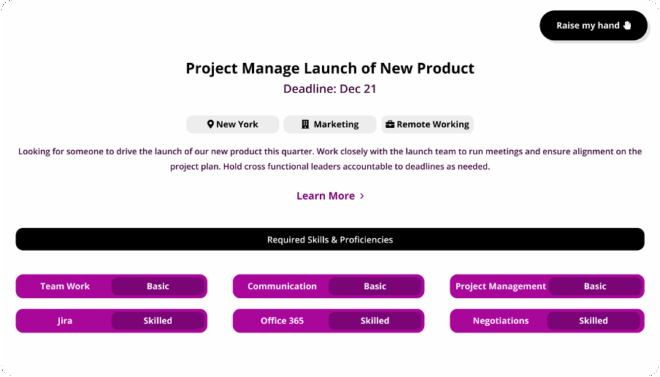
Fuel50’s Talent Marketplace, gigs, and mentoring features help organizations do this at scale by matching people to short-term projects, stretch assignments, and mentors based on their skills and aspirations. You can uncover employees who hone AI skills as candidates for AI-heavy projects or cross-functional initiatives, while mentors who already work fluently with AI can support colleagues through focused guidance.
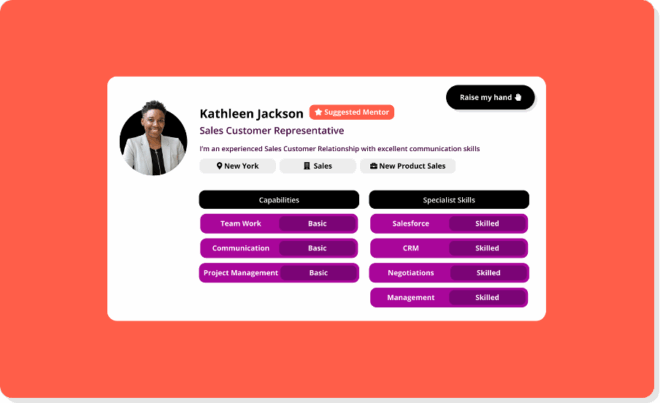
Internal mobility tools then make it easier to move reskilled employees into roles where AI capabilities are central, turning developmental effort into visible career progression rather than mere side activity.
Step 5: Measure progress and continuously recalibrate your AI skills strategy
An AI-ready workforce strategy can’t be static because the underlying technology and task mix will keep shifting. Organizations need a feedback loop that shows whether AI-critical skills are growing, where gaps remain, and which interventions create tangible movement.
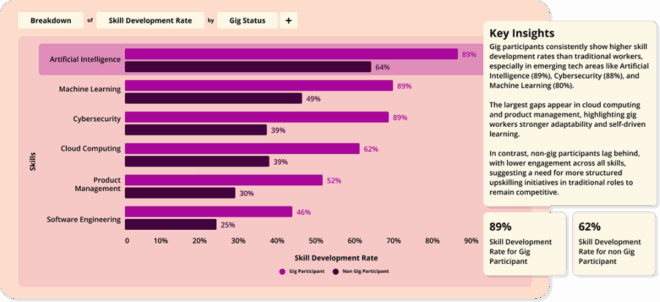
Fuel50’s Insights, skills analytics, and succession capabilities give leaders this continuous view by aggregating data on skills proficiency, learning engagement, internal moves, and pipeline strength for AI-exposed roles.
You can see which AI-related skills are gaining traction, where attrition threatens critical capabilities, which teams depend on a small group of “AI-fluent” employees, and how internal mobility or mentoring affects tenure. That evidence allows you to adjust your skills blueprint, refresh in-demand skills, redirect your learning investment, and refine career paths as AI continues to reshape work.
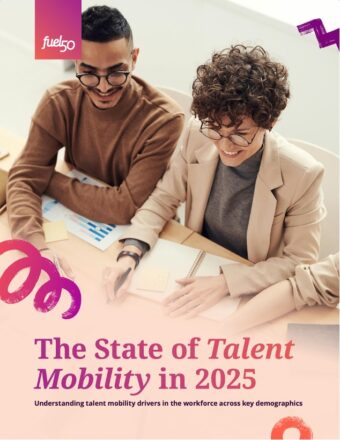
Download ‘The State of Talent Mobility in 2025’ Report here: https://info.fuel50.com/the-state-of-talent-mobility-in-2025